Technology e-commerce (Germany) — Build
200,000 products synced every 5 minutes.
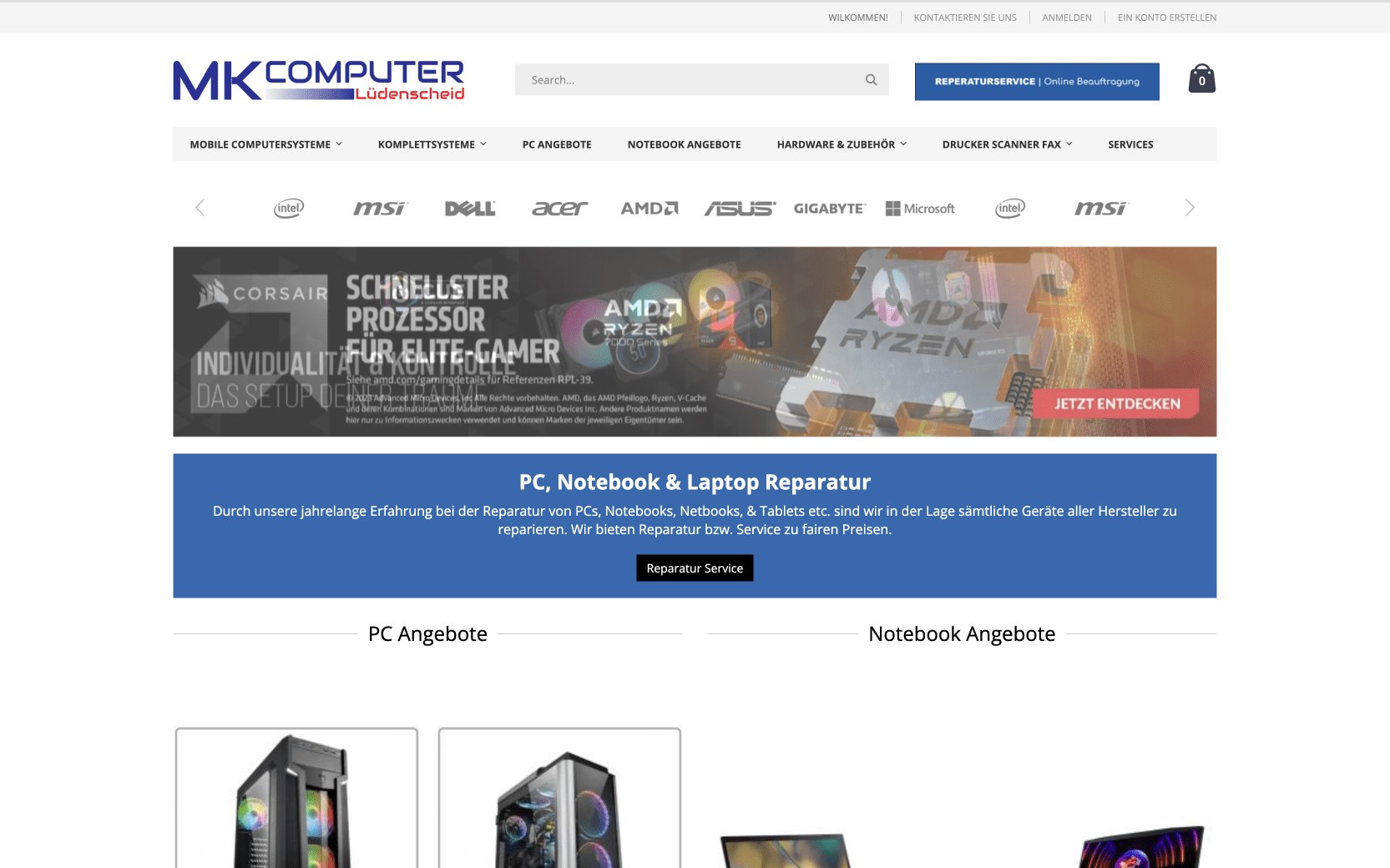
MKComputer wanted to dropship 200,000+ products from the SYNAXON catalogue across Europe; stock and pricing couldn't be managed by hand. We built an automation platform on Magento 2 that syncs stock, price and supplier every 5 minutes.

- Duration
- 4 months
Measured results
- Products synced
- 0,000+
- Stock, price, supplier, image and description
- Update interval
- 0 min
- Full catalogue, automatic 24/7
- Manual order steps
- 0
- Orders route automatically to the best supplier
01 — Challenge
- Stock, price and supplier data for 200,000 products changed too fast and too broadly to update by hand.
- Order routing was manual; finding the right supplier for each order took time.
- Specification-based search (e.g. 8, 16 or 32 GB RAM) across hundreds of thousands of products wasn't possible on the existing stack.
02 — Approach
- 01A custom Magento 2 module was built for SYNAXON's XML feed; an end-to-end data pipeline with SOAP, XML and PHP.
- 02A dedicated server architecture was configured to carry the 5-minute sync load; database and frontend optimised.
- 03Specification-based smart filtering and a conversion-focused interface were designed; each order routes automatically to the best supplier.
03 — Outcome
- Stock, price, supplier, image and description data for 200,000+ products updates automatically every 5 minutes.
- Orders route to suppliers without human intervention; sales run with no stock, warehouse or logistics cost.
- The platform is live across Europe; search and purchase work on specification filters.
Frequently asked questions
How do 200,000 products refresh every 5 minutes?
The refresh runs through a custom Magento 2 module reading SYNAXON's XML feed. The module pulls stock, price, supplier, image and description fields and matches them against the catalogue, and the loop runs automatically around the clock. The five-minute interval is not arbitrary: in a dropshipping model, stale stock data means a sold product is missing at the supplier and the order turns into a cancellation.
Which technologies were used?
The platform was built on Magento 2, with the data pipeline written in SOAP, XML and PHP. Those components form one end-to-end flow, and a dedicated server architecture was configured to carry the sync load on top of it. Database and frontend were optimised separately, because continuous writes and visitor traffic run on the same system.
Why a custom module instead of an off-the-shelf extension?
Volume and refresh interval together demanded a purpose-built pipeline. Updating more than 200,000 products every five minutes was only possible with a module written against the supplier's own data format; a general-purpose import extension does not meet both conditions at once. The order routing logic also lives inside that same module.
How does an order reach the supplier?
Each order routes automatically to the right supplier, with no manual step left in the process. Previously, finding that supplier was done by hand for every order, which made response time depend on individuals. At MKComputer the product, price and supplier match is kept current by the sync, so the routing decision now sits with the system.
How does search work across hundreds of thousands of products?
Search works through specification-based filters. Buyers narrow by technical criteria such as 8, 16 or 32 GB of memory, which the previous stack could not do — hundreds of thousands of products were effectively unbrowsable. The filter flow was designed together with a conversion-focused interface, so narrowing leads straight into the purchase step.
How does the dropshipping model change costs?
The model removes stock, warehouse and logistics cost. Product stays with the supplier, the sale happens through MKComputer and the order routes straight back. The saving only holds while the data is current: a stale price eats the margin and stale stock turns an order into a cancellation. That is why sync, not the interface, sits at the centre of the build.
Where does the platform run today?
The platform is live across Europe. Catalogue, specification search, purchase and order routing all run on this setup. As a Germany-based technology retailer, MKComputer sells into several markets from a single installation, and product data in every market is fed by the same sync loop.
Would the same setup work for another catalogue?
The setup works when the supplier provides a structured feed. SYNAXON's XML feed existed at MKComputer; without a feed, or with inconsistent fields, the work turns first to data quality and automation moves to the second step. As product counts rise, sync interval and server architecture get designed together, because each sets the other's limit.
Which services does this work fall under?
The work falls under custom software and mobile apps, e-commerce, business automation and conversion optimisation. Module development, server architecture and interface work ran inside the same project. Four services meeting in one job is not a coincidence: without the pipeline the interface stays empty, and without the interface current data never turns into sales.
Where would a similar project start?
The starting point is an audit of the supplier feed. Which fields arrive, how often they change and in what format together determine both the sync interval and the server requirement. No decision on Magento, servers or interface is taken before that audit closes; the architecture is shaped by the volume and irregularity of the feed.
Related cases
View all





Where do we start?
Three entry doors at three speeds. Pick the one that fits.