Industrial manufacturing — mechanical seals — Transform
10× more quote requests, driven by an AI technical advisor.
Meccanotecnica Umbra is the Türkiye arm of one of the world's leading mechanical seal manufacturers, yet its technical visibility in the local market lagged behind its global standing. We connected the product catalogue to an AI advisor that lays out the right equipment for an engineer describing their plant, and to a quote portal. Quote requests rose tenfold and response time dropped by ninety percent.
- Duration
- 5 months
- Disciplines
- Custom software & mobile apps · AI advisory · Business automation
Measured results
- Quote requests
- 0×
- After the portal and AI advisor went live
- Faster response
- 0%
- The request-to-response step runs in CRM automation
- Monthly organic impressions
- 0,000
- Still climbing; on an architecture built from scratch
- Google ranking
- Top 0
- Every target keyword, mechanical seals included
01 — Challenge
- A globally leading brand had fallen behind on technical and market visibility in Türkiye.
- Engineers couldn't work out which equipment suited their own plant; every choice needed expert support.
- Products couldn't be found or compared online; the quote process ran on phone calls and email.
- Quote requests were handled manually; response time and follow-up depended on individuals.
02 — Approach
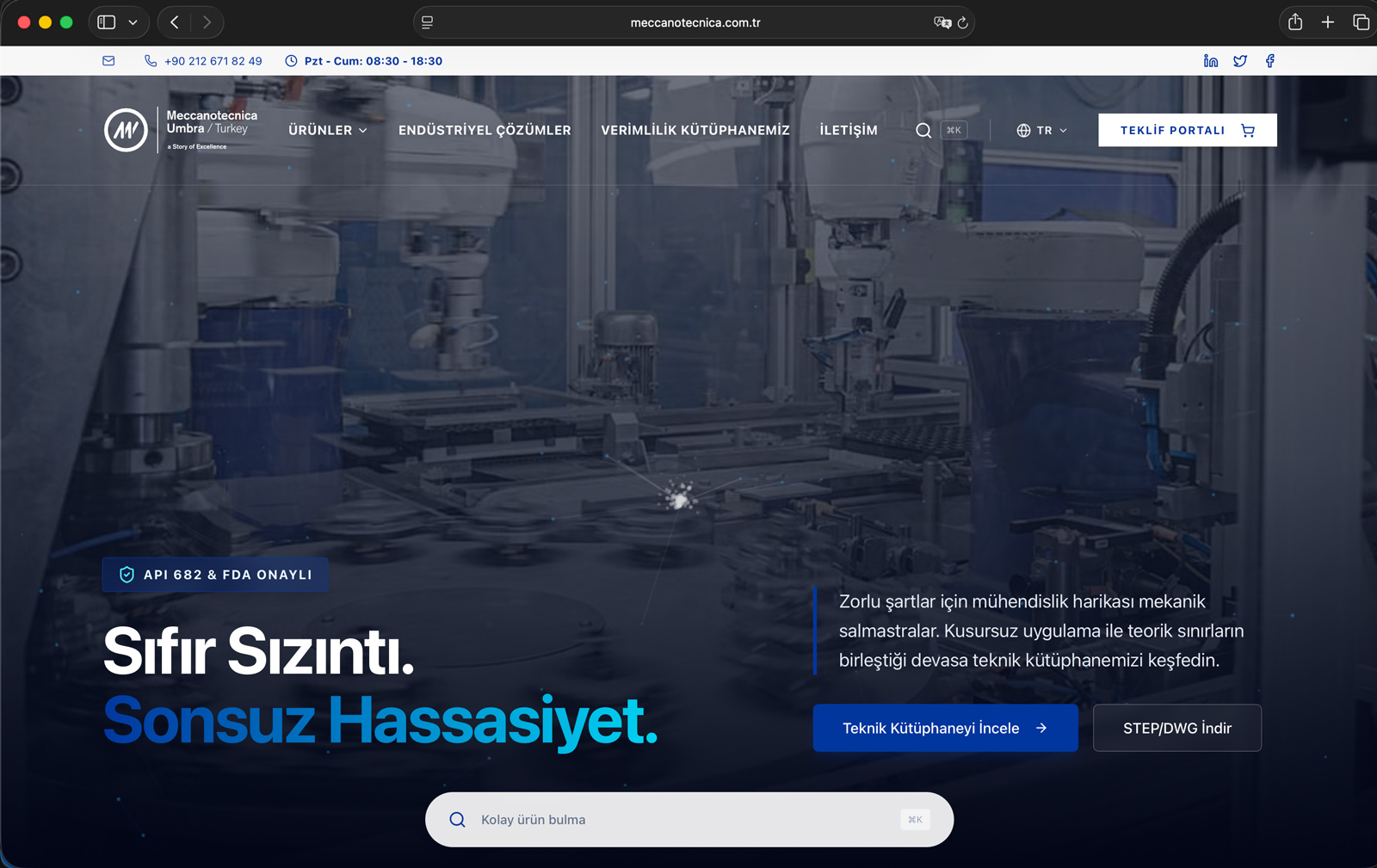
- 01We built the product catalogue with e-commerce depth: every product live with its technical description, imagery and a downloadable CAD file (STEP/DWG).
- 02We placed an AI technical advisor in a chat interface: the engineer describes their plant and the system lays out equipment for the whole facility in a single form.
- 03A command-palette search lets engineers find what they need in seconds, tying discovery straight to the quote step.
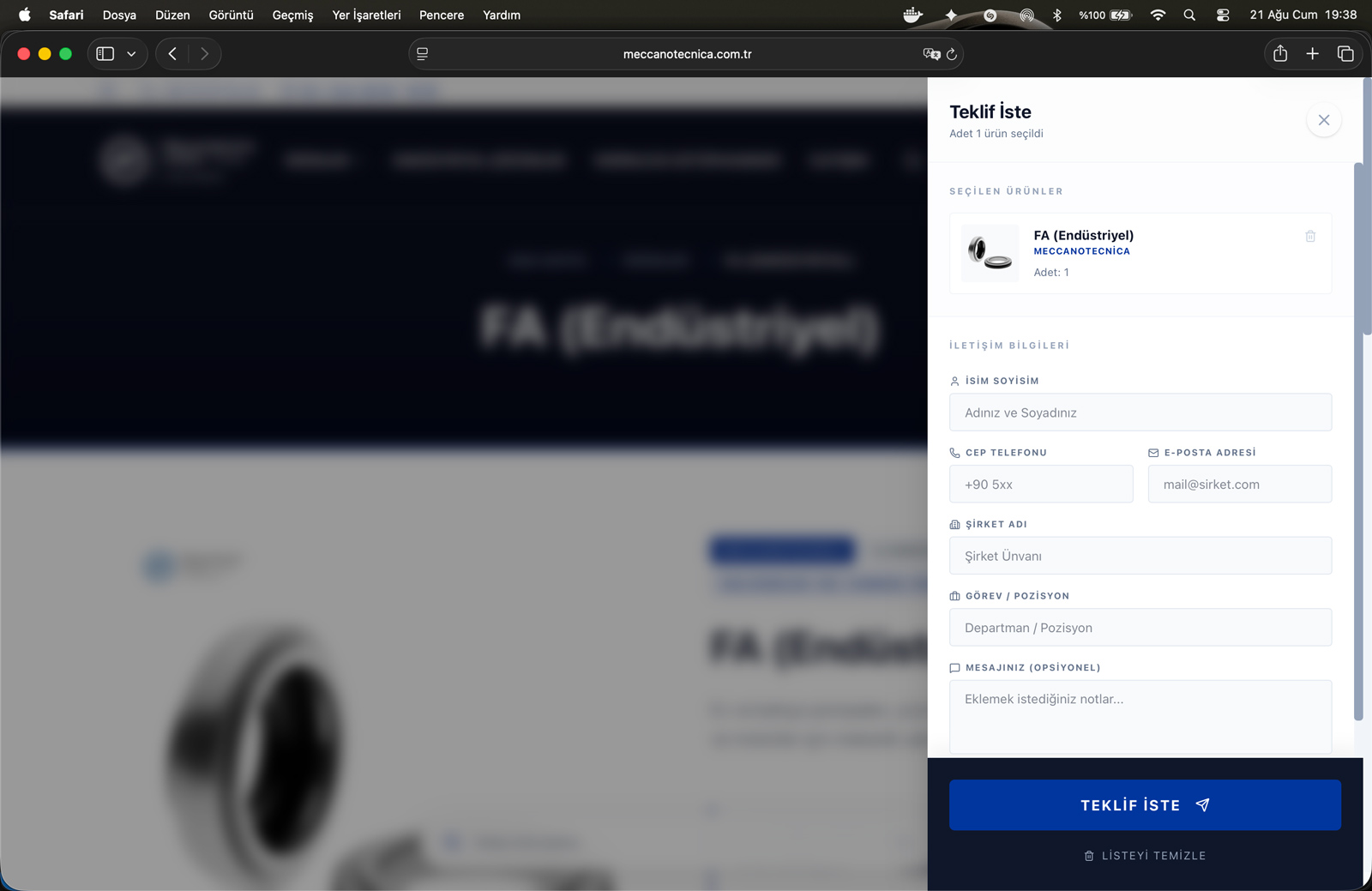
- 04In the quote portal buyers add multiple products to a list and send one form; the request lands in CRM automation, with data reaching the brand and a response reaching the customer automatically.
- 05The SEO and GEO architecture was built from scratch in four languages (TR, EN, AR, RU), positioning target and adjacent-market keywords in one structure.
03 — Outcome
- Quote requests rose tenfold; engineers now find products and build their own lists.
- The time between request and response fell by ninety percent — the step moved into CRM automation.
- Monthly organic impressions reached 15,000 and keep climbing; the brand ranks top 5 for every target keyword.
- The four-language structure covered adjacent markets, and the Türkiye interface moved ahead of the brand's global sites.
Field record
Our customer describes their plant and the system lays out the right equipment. Quote requests are up tenfold, and the wait for a response has all but disappeared.
Frequently asked questions
What does the AI technical advisor do?
The advisor lays out the equipment that fits the plant an engineer describes. The buyer describes their facility in a chat interface and the system lists suitable products for the whole site in a single form. Previously that selection could not be made without expert support, and every question turned into a phone call. In mechanical seals the right choice depends on variables such as operating pressure and the fluid handled.
Why did quote requests rise tenfold?
The rise came from engineers now being able to build their own list. The discovery flow was tied straight to the quote step, so a buyer adds several products to a list and sends one form. Before that the process ran on phone and email, and every request needed human follow-up. Once the friction went, request volume rose, because asking had become cheap.
How did response time fall by 90%?
The drop came from the request-to-response step moving into CRM automation. An incoming request lands in the system automatically, with data reaching the brand and a reply reaching the customer at the same moment. Previously the step was handled by hand and both timing and follow-up depended on individuals. Automation added consistency as well as speed: every request is now recorded the same way.
How does an engineer find the product they need?
Discovery runs through command-palette search and a catalogue built to e-commerce depth. Every product is live with its technical description and imagery, and search reaches a result in seconds. Before, products could neither be found nor compared online. The catalogue architecture was deliberately built to an e-commerce standard, because industrial buyers now expect the speed of consumer interfaces.
Why are CAD files published on the site?
The files are published so an engineer can verify their choice. A STEP or DWG file is downloadable for every product, letting a buyer test the part in their own design before moving to the quote step. In industrial purchasing, verification comes before the buying decision, and when that step cannot be done on the site the process can end in a change of supplier.
Why were four languages chosen?
The languages were chosen against the target and adjacent markets: Turkish, English, Arabic and Russian. The SEO and GEO architecture was built from scratch in all four, positioning keywords inside a single structure. The four-language build also covered adjacent markets, and by the end of the engagement the Türkiye interface had moved ahead of the brand's global sites.
Why was a global brand's local site built from scratch?
Local technical visibility lagged behind the global position. Meccanotecnica Umbra is the Türkiye arm of a world-leading manufacturer, yet in the local market products could neither be found nor compared online and the quote process ran on the phone. Rather than waiting for global sites to adapt to local search language and buyer habits, the structure was built on the questions of the Türkiye market.
What was measured on the search side?
Measurement ran on monthly organic impressions and ranking. Impressions reached 15,000 and keep climbing, and the brand ranks in the top 5 for every target keyword, mechanical seals included. Impressions are the indicator that arrives before clicks, and on an architecture built from scratch they give the first signal, because visibility can be measured before ranking settles.
How long did the project take?
The project ran 22 weeks, roughly five months. That span covered the catalogue architecture, the AI technical advisor, the quote portal, the CRM connection and the four-language search structure together. The pieces were not delivered separately: since the quote flow only means something once catalogue and advisor work together, all three went live in the same release.
Would the same setup work for another industrial manufacturer?
The setup works where there is a technical catalogue and a selection problem. The lever is not the number of products but the buyer's inability to choose the right one alone. Where selection is simple, an AI advisor becomes overhead and the real gain sits in the quote portal and CRM automation. The precondition is structured product data — a scattered catalogue gets organised first.
Which services does this work fall under?
The work falls under custom software and mobile apps, AI advisory and business automation. The three converged in a single application, with the four-language search architecture built as part of the same structure. The case sits in the Transform discipline, because the real gain was not a new product but an existing sales process measurably speeding up.
Related cases
View all
 $1.5M — Revenue
$1.5M revenue in 6 days, e-commerce.
E-commerce & retail

 12× — Sales
12× sales in 3 months, sportswear.
Sportswear e-commerce
 200,000+ — Products synced
200,000 products synced every 5 minutes.
Technology e-commerce (Germany)
Where do we start?
Three entry doors at three speeds. Pick the one that fits.